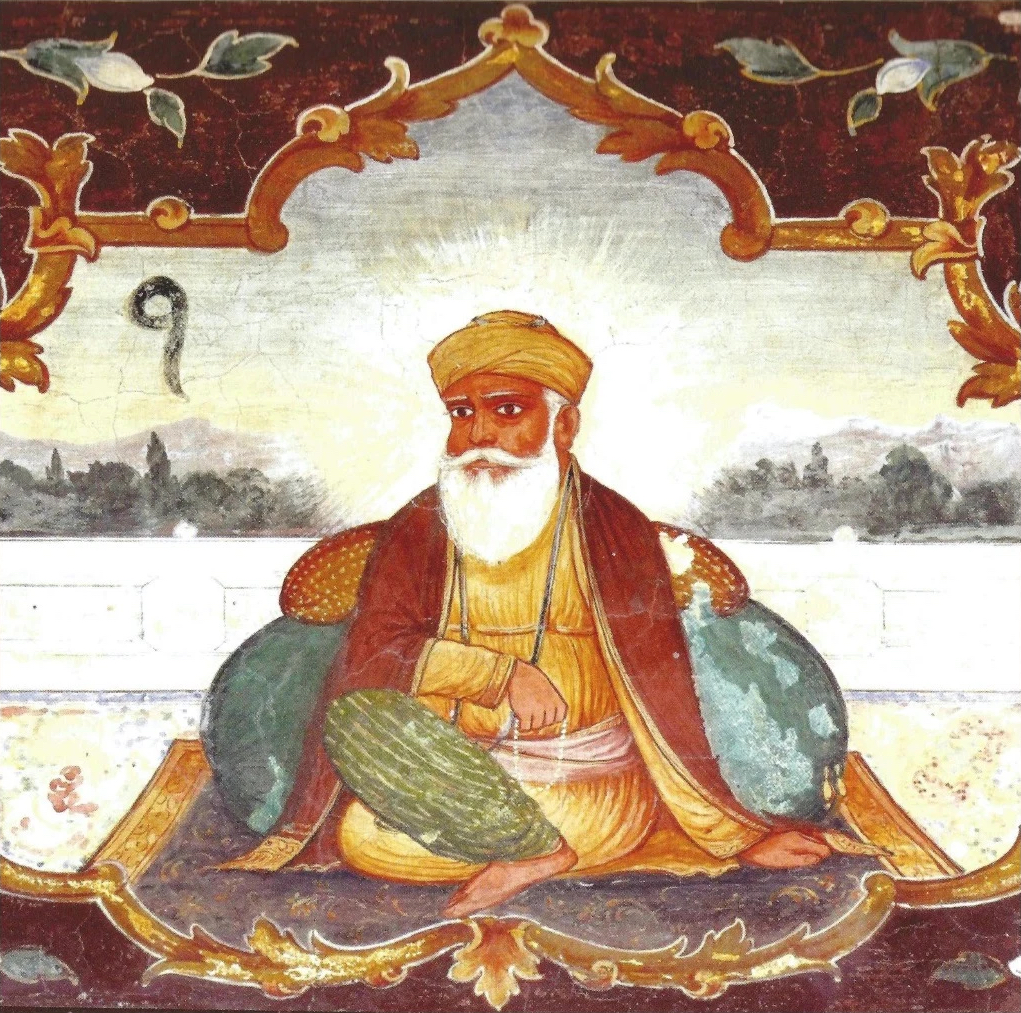
Guru Nanak Dev Ji was the founder of Sikhism and the first of the ten Sikh Gurus. Often affectionately referred to as Baba Nanak ("Father Nanak"), he is remembered not only as a religious founder but as a mystic and poet whose hymns still form the backbone of Sikh scripture. Born in the Punjab region of what is now Pakistan, he spent his life challenging religious division and social inequality, teaching that there is one formless God shared by all people regardless of faith, caste, or background. His life and teachings remain the foundation of Sikh belief and practice today.
Early Life
Nanak was born in the village of Rai Bhoi di Talwandi, today known as Nankana Sahib, near Lahore, Pakistan. His father, Mehta Kalu, worked as a village accountant, and his mother, Mata Tripta, was known for her devotion. His elder sister, Bebe Nanaki, is traditionally regarded as the first person to recognize his spiritual gift. From childhood, Nanak showed an unusual seriousness about spiritual questions, and he grew uneasy with religious rituals that he felt had lost their meaning.
As a young man he married Mata Sulakhani in 1487, and the couple had two sons, Sri Chand and Lakhmi Das. The family settled in Sultanpur Lodhi, where Nanak took work managing a local granary. It was here, according to Sikh tradition, that he experienced a profound spiritual awakening after going missing for three days while bathing in a nearby river. When he reappeared, his first words were said to be: "There is no Hindu, there is no Muslim," a declaration that all people share the same divine origin, beyond the labels that divide them. Around this period he is also credited with composing the Mool Mantar, the opening verse of the Guru Granth Sahib that sets out the basic nature of God in a few compact lines, regarded by Sikhs as the seed of the entire scripture.
A note on dates: Most historical sources give Guru Nanak's birth as 15 April 1469, though Sikh tradition has long celebrated his birthday (Gurpurab) on the full moon of the month of Katak (October–November) instead, a discrepancy scholars have never fully resolved. Both dates appear across reputable sources, so you may encounter either depending on where you look. He died on 22 September 1539 at Kartarpur, aged 70.
Core Teachings
Guru Nanak's teachings rest on three central principles that remain at the heart of Sikh practice:
- Naam Japna: keeping God constantly in mind through remembrance and meditation, rather than through ritual.
- Kirat Karni: earning an honest living through one's own effort, rejecting both idleness and exploitation.
- Vand Chakna: sharing what one has with others, especially those in need, as an expression of community and compassion.
He taught that God (Ik Onkar, ੴ, "One God") is one, formless, and present in all beings, meaning that no person is closer to God because of caste, gender, or religion. This was a radical position for 15th-century South Asia, and Guru Nanak spoke out directly against the caste system, the mistreatment of women, and empty ritualism in both Hindu and Muslim practice of his time.
His Hymns and Their Place in Scripture
Guru Nanak was a prolific poet, and his teachings survive largely through his own compositions, traditionally said to number in the high hundreds of hymns, or shabads, later incorporated into the Guru Granth Sahib. (Exact counts vary between sources depending on how individual verses, saloks, and pauris are tallied, so treat any single figure as approximate rather than definitive.) Among the best known are the Japji Sahib, a foundational morning prayer that opens the scripture and distills much of his core philosophy; the Asa di Var, a set of hymns often described as a "ballad of hope"; and the Sidh Gosht, which records a dialogue between Guru Nanak and a group of Siddha yogis on the nature of true renunciation.
Sikhs believe that the same spiritual authority carried by Guru Nanak passed, in turn, to each of the nine Gurus who followed him, meaning all ten are regarded as sharing one continuous spiritual light, rather than as ten separate teachers with separate messages. This belief is part of why all ten Gurus signed their compositions with the name "Nanak," and why the Guru Granth Sahib today is treated as the eternal, living continuation of that same authority.
The Journeys (Udasis)
Beginning around 1500 and continuing for roughly two decades, Guru Nanak undertook a series of long missionary journeys known as the Udasis. Most accounts describe four major journeys, though some of the older Janamsakhi traditions (early biographical accounts of his life) count five. Between them, he is estimated to have covered tens of thousands of kilometers, mostly on foot:
- East: through northern and eastern India as far as Assam and possibly Bengal
- South: down through India to Sri Lanka
- North: into the Himalayan regions, including Kashmir and Tibet
- West: the longest and most demanding journey, crossing into Afghanistan, Persia, and Arabia, including, according to Sikh tradition, visits to Mecca and Medina, and a well-known dialogue with the Sufi scholar Bahlol Dana in Baghdad
He was accompanied for much of this time by his close companion Bhai Mardana, a Muslim musician of the Mirasi community, who set Nanak's hymns to music on the rabab, a stringed instrument. On these journeys, Guru Nanak engaged religious leaders of many traditions, Hindu yogis, Muslim clerics, and Buddhist monks among them, in direct dialogue, encouraging each to live sincerely by their own faith rather than adopting his.
Kartarpur and the Foundation of Sikh Community Life
Around 1521–22, in his final years, Guru Nanak settled in Kartarpur, on the banks of the Ravi River, where he lived as a farmer and taught a growing community of followers. It was here that he established Langar, the practice of a free communal kitchen where people of all backgrounds sit and eat together as equals, a tradition still central to every Gurudwara today. This period also shaped the model of the Sikh householder: someone who lives an ordinary working life while remaining devoted to God, rather than withdrawing from the world.
Before his passing in 1539, Guru Nanak chose his most devoted disciple, Bhai Lehna, to succeed him, installing him as Guru Angad Dev Ji, the second Sikh Guru. This began an unbroken line of spiritual succession that would continue through ten Gurus, ending with Guru Gobind Singh Ji's declaration that the Guru Granth Sahib, the Sikh holy scripture, would serve as the eternal Guru.
Why Guru Nanak Still Matters
Today Sikhism is practiced by an estimated 25–30 million people worldwide, making it the world's fifth-largest organized religion. Guru Nanak's core message of one God, human equality, honest work, and selfless service continues to shape Sikh identity and practice everywhere Sikhs have settled, including within Switzerland's own Sikh community. Every Gurudwara, wherever it is in the world, still opens its doors to all visitors and still serves Langar freely to anyone who walks in, regardless of their background. That practice traces directly back to the community Guru Nanak built at Kartarpur over 500 years ago.
His birthday, Guru Nanak Gurpurab, remains one of the most widely celebrated events in the Sikh calendar, marked with processions, continuous scripture readings, and community meals in Gurudwaras around the world, including here in Switzerland.
Further Reading
For readers who want to go deeper than this overview, the following are useful starting points:
- Sri Guru Granth Sahib Ji
- SikhiWiki
- Sikh Missionary Society (UK)
- W.H. McLeod, Guru Nanak and the Sikh Religion